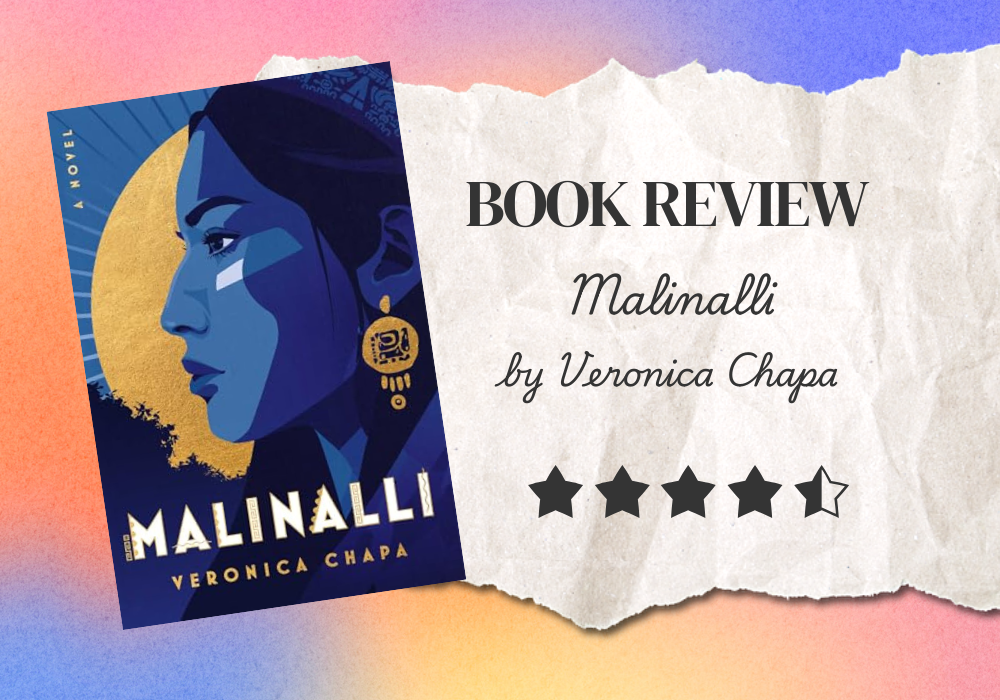
If you’re of Mexican descent, or are familiar with Mexican history, you’ve probably heard the story of La Malinche. An enslaved, indigenous woman who helped Hernán Cortés conquer the Aztec Empire by acting as his translator. To this day, some people continue to blame her for the fall of the Empire. Others are sympathetic to her plight.
La Malinche, also known as Malinalli, Malintzin, Doña Marina and Malinalxochitl, was only a child when she was either sold or kidnapped into slavery. She was a very young woman, about 18, when she was gifted to Cortés by the Maya at Potonchán.
Day Malinalli (Grass, known as Eb in Maya) is governed by Patecatl as its provider of tonalli (Shadow Soul) life energy. This day signifies tenacity, rejuvenation, that which cannot be uprooted forever. Malinalli is a day for persevering against all odds and for creating alliances that will survive the test of time. It is a good day for those who are suppressed, a bad day for their suppressors.
Aztec Calendar
It was only when Moctezuma’s (the leader of the Aztec Empire) emissaries came to inspect the Spanish that Cortés realized his own interpreters, who only spoke Yucatec Maya and Spanish, could not understand these Nahuatl-speaking emissaries. La Malinche, however, could. Soon, she would begin serving as Cortés’s “tongue,” speaking Yucatec Maya, Nahuatl, and Spanish effortlessly.
La Malinche’s talent for language earned her more “freedom” with the Spanish, and Cortés even took her as is concubine, later bearing him a son known as “El Mestizo.”
It can be said that La Malinche’s services helped Cortés conquer The Aztec Empire due to her ability to translate between Yucatec Maya, Spanish, and Nahuatl, but it can also be said that La Malinche didn’t act out of free will. She was, at the end of the day, still enslaved. With or without her skill set, Cortés would have likely taken Moctezuma’s throne no matter what.

Why Is La Malinche’s Story So Important?
Patriarchy loves to blame women for everything. Miscarriage? Her fault. Can’t get pregnant? Her fault. Assaulted? Her fault. Abused? It must have been HER FAULT!
The same can be said for the fall of the Aztec Empire it seems. It must have been (in-part) fault of a woman.
Thus, La Malinche’s history has often been summarized as that of a traitor to her people, while others, who seemingly support the Spanish colonization have called her the mother of Mestizos.
In more recent decades, feminists have sought to redefine the way her story is shared, often calling out that she was a victim, not the conqueror.
Women are often pigeon-held into two defining characteristics: Eve or Lilith, Santa or Puta, Pure or Dirty, Virgin or Whore. There is no in-between, especially in conservative, Catholic-Christian societies.
I don’t know the way women were treated in Mexico before the Spanish came, but from what I’ve read, I can surmise that women were not seen as leaders, warriors, or powerful. When the Spanish came, their roles were further reduced to whatever the Spanish seemed fit for Indigenous women, which was likely no more than concubine, mother, caretaker, homemaker, or woman of God.
Either way, it’s clear that the role of women in pre-Colombian Mexico were no better than the roles we’re ascribed, and subjected to today. And La Malinche’s story serves as a reminder that women have not been treated fairly in over 500 years.
Why “Malinalli” by Veronica Chapa Matters
Malinalli is a powerful re-telling La Malinche’s story. Retelling stories often focus on European mythology and figures from older European times. Rarely do we get a retelling with Mayan or Aztec mythology. Even rarer do we get a retelling of a historic Mexican figure. Upon reading some reviews, I noticed readers missed the plot of this book entirely. If you’ve never been discriminated against for being a woman or don’t understand the power of pre-Colombian Mexico, then you’ll never understand the beauty of Malinalli. This is not “just another retelling” story. This is a reclamation. A justification. A story that needed to be written and shared.
To summarize plainly, this book gives context to La Malinche. It gives her a backstory where she seeks vengeance for her family, thus sparking a personal vendetta against Moctezuma. On her journey to get justice, she becomes a priestess, falls in love, is captured into slavery and sold in the market, used as a concubine, gifted to the colonizers, becomes a powerful sorceress, and a political figure. She does get justice, but Chapa ensures the readers feels it is justified. By the end of the book, you feel Moctezuma got what he deserved, yet you also feel the shame La Malinche feels for her part in the fall of Tenochtitlan.
The fictional character Malinalli knows deep loss. She is not unaffected by the everyday human plight, nor is she immune to the pain of being a woman in a man’s world. She’s used, abused, but never once does she keep her head down and give up. She fights, and fights, like all the Mexican women I know. Pain, struggle, and loss has always been our norm.
Malinalli empowers us to be La Malinche, to embrace power and fight back, never back down. It’s a reclamation of womanhood, of indigineity, of our power as women.

why I Love This Book
First of all, Veronica Chapa’s skills as a writer are unmatched. The way she writes makes me feel like I am hearing the character’s story first-hand. Like I am listening to a real-life account. The story is written in first person from Malinalli’s perspective, letting us see for ourselves the life she lived and experiences she survived. The language she uses is accessible, non-discriminatory, and powerful. She knows the power of language, like La Malinche did. Her prose is like magic, much like the magic her characters create.
Not only is Chapa a powerful writer, she also honors pre-Colombian Mexican history with accurate names and depictions of the tension between the Aztec Empire and it’s conquered cities. I am not afraid to admit that I have been guilty of romanticizing the life before colonization, but Chapa makes is clear this life was no walk in the park. The life of a woman during these times was just as hard as it is today. History does not repeat itself, but it sure rhymes, and you can see that in Chapa’s writing.
I was also deeply moved by her descriptions of areas in the Yucatan, and the Aztec capitol. Reading about Tenochtitlan through Malinalli’s eyes was almost like seeing it for the first time myself. I’ve always longed to visit Mexico City, but reading about it’s original foundation was fascinating. I yearn to know what this magical city looked like. I yearn to see what remains and survived. My ancestors are not Aztec or Maya, but I long to know more of their beautiful histories. (My ancestors are from the west coast of Mexico.)
I listened to this as an audiobook, borrowed from my local library, but I am leaning towards re-reading the physical print version. There were many quotes about freedom, power, and justice that resonated with me that I wish to share on social media. Unfortunately, it’s hard for me to capture quotes with audiobooks. However, hearing the proper pronunciation of the Nahuatl words was very educational for me. I highly recommend an immersive listening and reading experience of this novel.
📖 Read this Book If
- You like Gods of Jade and Shadow by Silvia Moreno-Garcia
- You like The Inheritance of Orquídea Divina by Zoraida Cordova
- You appreciate Aztec and Mayan mythology
- You love stories about bad bitch warrior goddesses