
*Warning: There are spoilers ahead and references to Sexual Abuse (SA) and Intimate Partner Violence (IPV).
Quick Summary
White Horse is a story about a woman, Kari James—a bartender, Metalhead, and urban Native from Idaho Springs, Colorado—forced to confront her mother’s mysterious past. Living psychologically safe within her bubble, Kari was comfortable living in the dark about her mother’s ghostly disappearance, pretending to be okay with thinking her mother abandoned her as a newborn. But once she comes into contact her mother’s bracelet, the truth unravels in ways Kari can no longer avoid by numbing with alcohol, cigarettes, and one-night-stands.
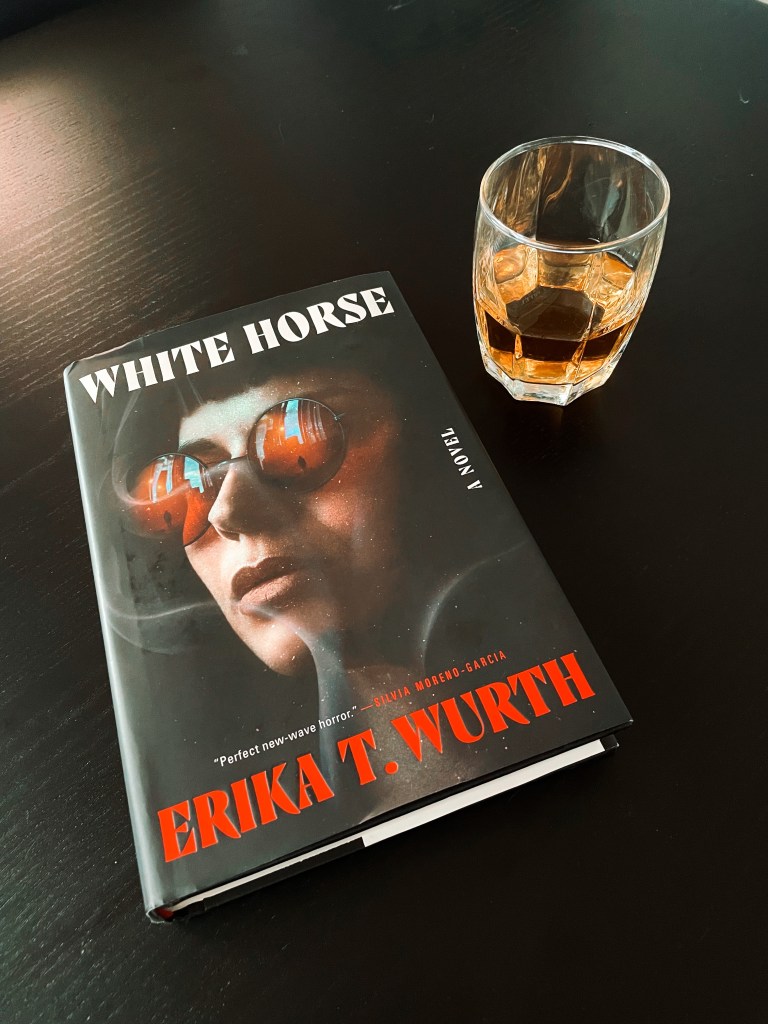
Kari James is a Bruja
Sometimes when writers write about witches or psychics, they forget about the shadow work needed before one can harness any psychic powers. Wurth did an amazing job taking us through the work Kari needed to do for her to align with her highest self. As she moves through the darkness that shrouds the mystery of her mother’s sudden abandonment, what seems like a haunting turns into divine guidance from her ancestors.
In White Horse, we witness the blossoming of someone with inherited trauma, a privilege that some people don’t experience because sometimes, people don’t come out of those experiences alive—like Kari’s mother, Cecilia, and so many other women who’ve been victims of SA and DV. Kari hadn’t been a victim of SA or DV, but she inherited that trauma from her mother while in utero. Without her mother (and father, for that matter) around to help her process the loneliness and pain that these experiences leave us with, she turned to whatever and whoever would help her feel nothing. Kari often swam in the rage of not knowing why her mother left her, leaving her feeling unloved and unworthy. She trauma-bonded with her best friend, Jaime, who sadly OD’d after nearly a decade of partying hard and using religiously. Kari wished it had been her instead. But even if Kari had tried, because she had, her ancestors and living relatives would not let that happen. She was divinely protected even though she did not know it.
But knowing you’re divinely protected and feeling you’re divinely protected are two very different things. Magic requires feeling, submission, and blind and unconditional faith in something you can’t tangibly see or logically interpret. Kari had to feel what her mother felt, she had to relive the experiences of her ancestors to harness the power she inherited from them. She needed to understand where she came from to understand the power she could wield. This is evident in how Kari goes from living her life passively as a bartender and waiter to owning her bar. She goes from being in the passenger seat to being in the driver’s seat of her life, which is what it feels like when you feel like your ancestors have your back.
“I had powers, and my children would have these powers. And their children.”
White Horse, p. 250 (Wurth)
Kari James comes from a long line of psychics and healers, a history stripped from her when her mother disappeared, but she has always been drawn to horror, metal, and the dark side. It hardly seems coincidental that one gravitates toward these subjects when these things run through your blood. Indigenous people of this continent know what true horror is: the cruelty of colonizers. In every horror story, it seems, we can find a way to relate. Kari consistently relies on The Shining by Stephen King to understand hidden messages and her bizarre connection to ghosts. In a way, understanding and exploring this novel helps her understand and explore her mysterious heritage.
These examples are just a few ways Wurth normalizes our connection with Spirit. Kari’s journey from being in complete denial to completely submitting to the power of her ancestors is a journey many detribalized Indigenous people are on. It’s like a path of rediscovery—a home that people tried to hide that we came back to anyway. Wurth writes about Kari interpreting dreams, thanking ghosts, and following her intuition so casually, but also leaves healthy room for skepticism to remind us that she is not easily trusting and she shouldn’t be. I’ve noticed many non-Indigenous writers will scarily write horror, something to be feared, something to be frightful about. But Wurth teaches us to submit to it. Learn from it. Lean into it—even.
Inherited Trauma & Repeating Cycles of Intergenerational Abuse
White Horse does for Micheal what I wish I could do for my father, a victim of and perpetrator of SA. In the end, she sends his ass to jail but keeps her connection with him healthy—there was no more hatred left to give him because her mother finally crossed over. Her mother had finally healed, something I wish for all the women in my family.
Indigenous communities experience IPV and SA at higher rates than non-Indigenous communities, a trauma cycle inherited from when the Spanish, Mexicans, and white Americans raped, pillaged, and stole their lands. These atrocities lasted for centuries and continue to hurt these communities, showing up like SA, IPV, and addiction. My dad was a victim, like Michael was, and a perpetrator like he was in similar ways. Seeing how Wurth likened Michael to a monster—the Lofa—made me think of the person drugs and SA trauma turned my father into. Though he’s laid to rest now, I did hope he would someday face his sins behind bars. It was really nice to see that for Michael, ironically.
You can’t talk about horror without talking about colonization and the cruel after-effects of it. Generations later, we’re still trying to heal from the sins of our ancestors, though they may have been victims or not, and face the horrifying truth. And it’s only through healing that we can find peace and understanding, strengthening our intution. When we’re no longer focused on survival, like one tends to be when reacting to trauma, we heal ourselves and, in turn, help heal past and future generations. And this is what I love about this book: Wurth gave Kari the ending all the women in my family so desperately deserve.
In Conclusion
★★★★★
I really loved this book. It felt close to home and very relatable, especially when Wurth wrote how Kari’s warrior outfit include short black combat boots. Me, too, Kari—me, too.
I’d recommend this book for any fans of Stephen King, Silvia Moreno-Garcia, and Stephen Graham Jones. Oh, and Shirley Jackson.
There are references to: drugs, metalhead music, sexual assault, and intimate partner violence. There are graphic scenes of gun-violence, bloody scenes, and a death description, which I found particularly beautiful and graceful. As graceful as you can get when describing what it feels like to die, I suppose.
Would I read this again? Absolutely. Let me just get through all my other unread books first (laughs in *delusional*).
Buy your copy from Bookshop.org:




 the bookish b*